
About Ladder of Growth

The story behind Ladder of Growth.

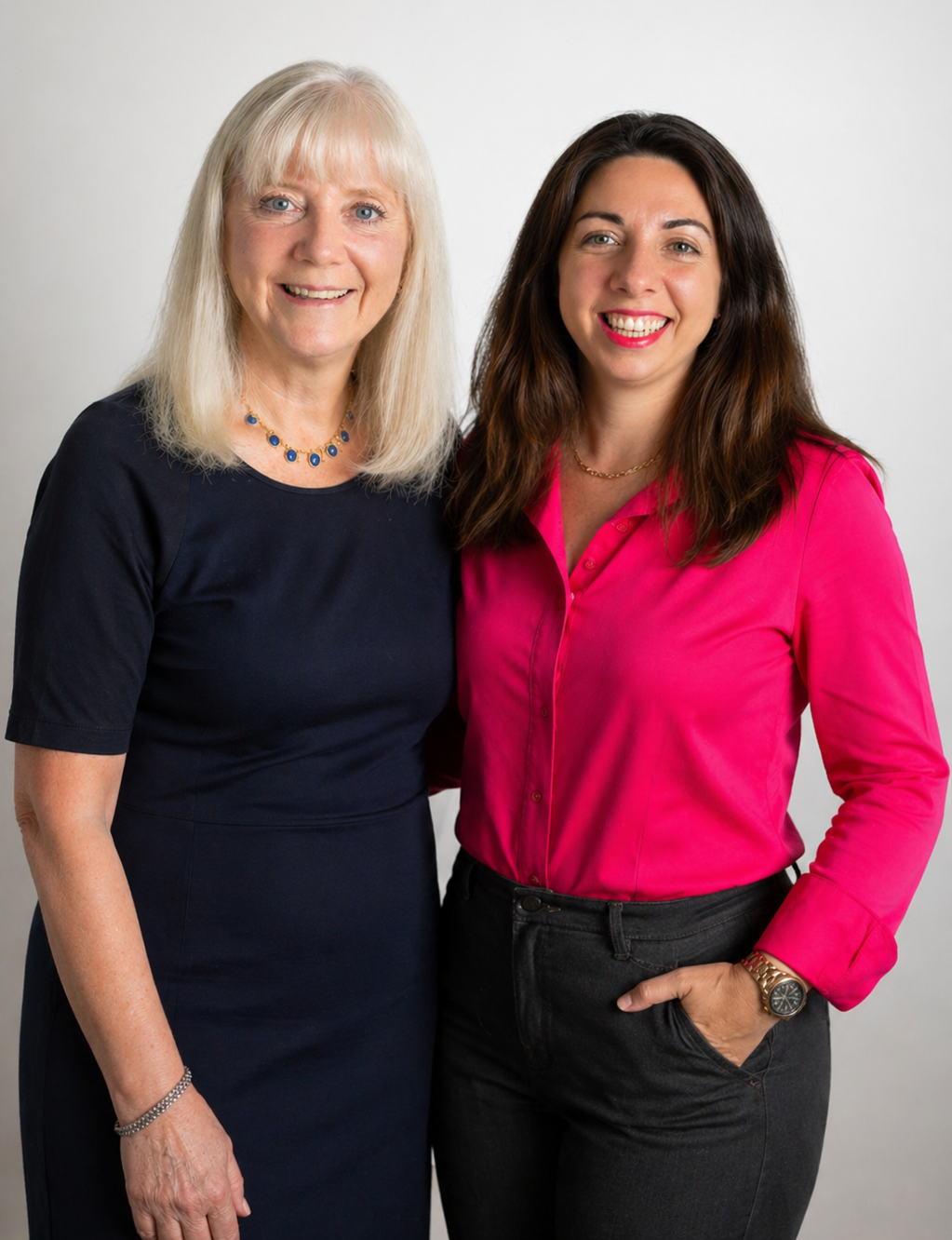
Two co-founders, 16 years of methodology, decades of personal development experience between them, and one question they kept asking before they decided to build the answer.

The origin

Why we built this.

Opening · The question

“Is it bloody working?”

That's the question we kept asking. Quietly at first, the way you ask difficult questions about your own work when you're not sure you want the answer. Then more and more openly as we realised there was no way of answering it.

Personal development is a sector where billions of pounds change hands every year. Coaching, therapy, courses, retreats, books, apps, supplements, programmes. People are doing the work, working hard at it, paying for it, hoping it's making a difference, and they have no way to know.

That's the gap LOG fills.

Alexia's angle

Alexia spent 16 years running Head Trash Clearance, an anxiety and emotional clearing system she developed through direct work with thousands of clients. She watched people change in front of her, week after week, year after year. People who arrived stuck and left clear. Patterns that had been running for decades, gone in months. The work was real. The change was real. What she didn't have was a way to measure it.

She'd describe what she'd seen and people would nod politely. Testimonials only carry so far. Without measurement, there's no difference between a system that genuinely works and one that just makes people feel temporarily better. Both produce nice quotes. Only one produces real change. And from the outside, you can't always tell which is which.

JJ's angle

JJ's early career in journalism gave her a respect for the facts, for evidence. As she transitioned into coaching, training and wellbeing, she started to notice a pattern both within herself and in others. It was this: not all personal development programmes stuck. You could feel euphoric after a weekend retreat but come crashing down days later. Interventions might work well in the short term but didn't always last. There was no way of fully understanding why. No hard evidence.

She would hear colleagues in the corporate world complain about how hard it was to win contracts in a sector that required measurement and proof of ROI. So much evidence of improvement was subjective, based on "How do you feel?" When the question should be: "Is this moving the needle, and can we track it?"

The convergence

In 2024, JJ met Alexia.

JJ had spent her whole life with tokophobia, a debilitating anxiety disorder around pregnancy and childbirth that's almost unknown outside the sparse clinical literature on it. She'd lived with it. She'd managed it. She'd built a successful career in spite of it. All without even knowing that was something she had. You don't know what you don't know.

Then she met Alexia, heard the word tokophobia for the first time, recognised that was her story, and cleared it. The change was profound. The difference between managing and resolving an anxiety disorder was huge. And the more JJ learned about Alexia's clearance work and measurement framework, the more convinced she became of its necessity and value.

The decision to build

We're not the people who would normally build a measurement company. We don't come from a quantitative psychology background. We don't have a research grant or institutional backing. We're two co-founders, no external investment, building this with what we know and what we've seen.

What we have is 16 years of direct observation of what changes when people do the inner work, and what stays stuck. What we have is decades of watching what gets taken seriously in this field and what doesn't. What we have is one founder who's lived through the difference between managing and resolving an anxiety disorder, and one founder who's helped thousands of others through the same difference. What we have is a model that came out of all of that, refined through thousands of practitioner hours, that maps how growth happens in stages we can name and measure.

In 2025 we co-founded Ascendrix Systems Limited and built Ladder of Growth.

We're still asking the question. Out loud. Every week on our podcast, Is It Bloody Working?

Co-founder

Alexia Leachman

Methodology and product

Alexia started her career in brand and marketing. She moved into coaching, and over 16 years built Head Trash Clearance, an anxiety and emotional clearing system that's now used by practitioners internationally. The system works. People have cleared decades-old patterns, reduced anxiety disorders by 80%, and recovered from severe phobias in weeks rather than years. The methodology is the product of long observation, refined through thousands of practitioner hours and published in four books.

Along the way she has trained an international network of Head Trash practitioners, taught the work at Oxford University, and built a podcast that's been downloaded over 2 million times.

What was missing, the entire way through, was measurement.

“Sixteen years of watching real change happen, and no way to prove it. That's the gap that became LOG.”

That's the work of the last few years. Alexia developed the Ladder of Growth model out of direct observation of how growth happens in stages, with recognisable patterns. The model became the backbone of every assessment LOG runs. It's also the measurement framework now embedded inside Alexia's own brands where the stakes are highest. Head Trash uses LOG measurement at four points across the brand experience. Fearless Birthing, Alexia's perinatal preparation brand, runs on a Custom Ladder Build for the Perinatal Inner Readiness Profile.

She built the Head Trash Clearance Club app herself, with AI tools, having no engineering background to start with. She mentions this not as a flex but because it tells you something about how LOG is built. She's the founder who learns what an SQL table is at midnight because something has to ship by morning.

Alexia is the author of Clear Your Anxiety For Good, Clear Your Head Trash and two further titles. She's based in France.

Co-founder

JJ Stenhouse

Communications and partnerships

JJ's early career was in journalism. She has worked as an anchor, correspondent, programme editor and producer across ITN, NBC, SABC, ITV, Channel 4, Sky News and Financial Times TV, as well as writer and sub-editor for the Daily Mail, regional UK newspapers and a long list of trade and consumer titles.

That's one body of work. Here's the second.

For nearly three decades she's worked as a media trainer and communication strategist in some of the most demanding rooms there are. Bechtel. Universal. Accenture. O2. Citibank. Deutsche Bank. London Business School. The Council of Europe's ten-year Democratic Leadership Programme, where she ran seminars at the training centres in Strasbourg and Budapest. The Open Society Foundation. The Westminster Foundation. The National Democratic Institute. The European Commission. Training senior leaders, NGO heads, government officials and political operators to communicate clearly under pressure in environments where unclear communication has consequences.

That career taught her what gets taken seriously in public conversation, and what doesn't.

“What gets measured gets taken seriously. Now the brilliant work done in the personal development field can benefit from that. LOG brings the receipts.”

Alongside the journalism and the communications work, JJ trained for 30 years across NLP, behavioural profiling, communication psychology, energy work and a range of healing and wellbeing modalities. NLP Master Practitioner. Demartini Method trained facilitator. LAB Profile consultant and trainer. Certified in Group Dynamics and Non-verbal Intelligence under Michael Grinder. The breadth matters less to JJ now than the pattern recognition it produced. After all that time training in different ways of reading people, she's developed an unusual ability to see what's happening in a person, a team or a system, beneath what's being said. She's also a practising medical intuitive.

In 2024 JJ met Alexia Leachman and resolved a lifelong tokophobia through Alexia's clearance work. That experience gave her a personal understanding of the difference between managing an anxiety disorder and clearing one. It's also what brought her into the LOG project as a co-founder.

Today JJ runs LOG's internal and external communications and partnerships, writing copy and holding conversations. She's the founder who keeps the language honest. She co-hosts the Is It Bloody Working? podcast with Alexia, where the two of them ask the question the LOG product is built to answer.

JJ is also a contributing author to Voices of the 21st Century: Conscious, Caring Women Who Make A Difference, New Makers of Modern Culture and The New Millennium Tales. JJ is based in Scotland.

jjstenhouse.substack.com

Clarity and reflection for authentic living.

What we're building toward

A long-term project.

A measurement standard.

That's what we're building. Not an assessment tool. Not a coaching app. Not another personal development product competing in a crowded market. A measurement standard.

The same way BMI is a measurement standard for body composition. The same way blood pressure is a measurement standard for cardiovascular load. The same way credit scores are a measurement standard for financial reliability. Standards aren't methodologies. They're the layer underneath that lets us know whether the methodologies are working.

The personal development field has never had one. Every brand and practitioner has measured their own work in their own way, with their own categories and their own success criteria. Which is fine for the brand and the practitioner. It's not fine for the person paying for the work who has no way to compare what they got from one approach to what they might have got from another. And it's not fine for the field as a whole because it can't build a real evidence base on a thousand different non-comparable measurement systems.

A standard fixes that. Independent measurement, applied consistently, across methodologies and across time. The data adds up. The evidence base builds. People working on themselves can see what's changing for them. Brands can prove their methodologies are working. Organisations can see whether their development investment is paying off. The whole field becomes more honest because it's harder to be dishonest when there's one measurement system everyone agrees on.

That's what we're building. It's a long-term project and we're only a few years in, but we're going to keep going until we finally set the standard and the LOG measurement becomes the norm.